









| 1)Choosing the Right Lenses There are many types of lenses and coatings - single vision, bi-focal, progressive, and computer lenses. We will explain the best options to match your current prescription and your daily needs. Hoya Sensity (Photochromic) Lenses Hoya Sensity Lenses are popular trend in California. They darken under sunlight and turn clear indoors for all-day comfort. For extra protection, Sensity Dark lenses even darken behind car windshields, making them ideal for driving. Both options help block up to 34 % blue light from computer monitors - protecting your eyes indoors and outdoors.  2)Understanding Lens Index The index number represents the thickness of a lens - the higher the index, the thinner the lens. The maximum index available is 1.74, which is nearly 50% thinner than standard plastic lenses. Recently, aspheric lenses have become more popular in higher index materials. In addition to being thinner, they also provide clearer vision with less distortion.  RX S-6.00 Left 1.67 index, Right 1.50 index 3) Relieve Digital Eye Strain with Hoya Sync Today, 65% of Americans experience symptoms of digital eye strain, yet 27% are unaware that computer eyewear can help protect their eyes. Hoya Sync lenses are designed for today's digitally demanding world, providing comfort and visual support for prolonged screen use. When combined with Recharge AR coating, they also reduce harmuful blue light exposure. Please consult our associates to learn more about the latest lens technology for your digital lifestyle.  Most people spend an average of 8- 10 hours a day looking at digital screens, with peaks up to 15 hours a day. Digital eye strain symptoms can presesnt themselves in as few as 2 hours of digital screen viewing. Sync Ⅲ lenses have a slight power boost design that will support and relax your eye muscles, relieving eye strain to let you focus more easily. Sync Ⅲ lenses work with any standard prescription. Sync Ⅲ can be used for distance and reading or intermediate and reading. If you are on a PC all day, Sync Ⅲ lenses are a solid pic. They are designed sepcifically for people spend extended hours in front of screens- offering enhanced near and intermediate vision zones compared to standard progressive or reading glasses. If you're mainly working on a desktop setup and don't need full distance vision during work hours, Sync Ⅲ lenses can make a noticeable difference. If you using Sync Ⅲ for PC, the center of the lenses is the intermediate RX and the lower power boost zone is the reading RX. 4) Experience the Difference with Hoya Progressive Lenses we are proud to offer high-quality Hoya progressive lenses. If you're trying progressive lenses for the first time, our associates will be happy to guide you through the process. We also offer a free trial with your current prescription, so you can see the difference between single vision and progressive lenses before you buy.  5) Hoya EX4 Meiryo Lens Coating Lens coatings continues to improve as technology advances, enhancing clarity, visibility and durability. Hoya EX4 Meiryo coating is available on any lens material and offers outstanding protection: 2.5 x harder scratch resistance Anti-reflective for clear vision Repels dust & water Smudge-free surface 360°UV protection Enjoy lenses that stay clearer, cleaner, and longer-lasting every day.  6) Blue Stop Lenses Recently Blue Light protection is most important for your eyes. Blue light is a part of the visible light spectrum and produce a higher amount energy, which could cause eye damage and the development of age-related macular degeneration. "Blue stop" lens selectively blocks the harmful type of blue light and helps reduce these effects. This lens protects eye against UV exposure indoors and outdoors. Now available in 1.56, 1.59, and 1.67 Hi-index single vision lenses. Photochlomic Blue Stop lenses are available in 1.59 & 1.67 Hi-index. Drive photochromic lenses which is good for night drive and night sports are available in 1.56 index lenses. This lens will turn yellow to dark green under the sun.  Drive photochromic lens  7) Lens Price Single Vision lenses are starting from $80 per pair, Bifocal lenses are starting from $150, and Progressive lenses are starting from $260. The price will vary from Lens thickness, frame's curvature, frame's size, and other options. If you bring your current RX, we will explain about your lenses. Please don't hesitate to ask any questions. We will meet your expectations as close as possible. Now, we are promoting a special package from $98 (including frame & single vision lenses). Blue stop lenses with frame are starting from $188. 8) Frame & Lens Curvature Every single frame & RX lens has a different base curve.  As you see, we will measure Lens base curve precisely by Lens Clock. Left pic has 9.5 base curve. This is mostly used for wrap-around Sunglasses. Most brand frames (center pic) have about 5.5 base curve. Most Asian-fit frames and some brand frames has 4 base curve. This 4 base curve is most suitable lens curve in most RX lenses. 0 base curve is flat surface. Next, lens curve. 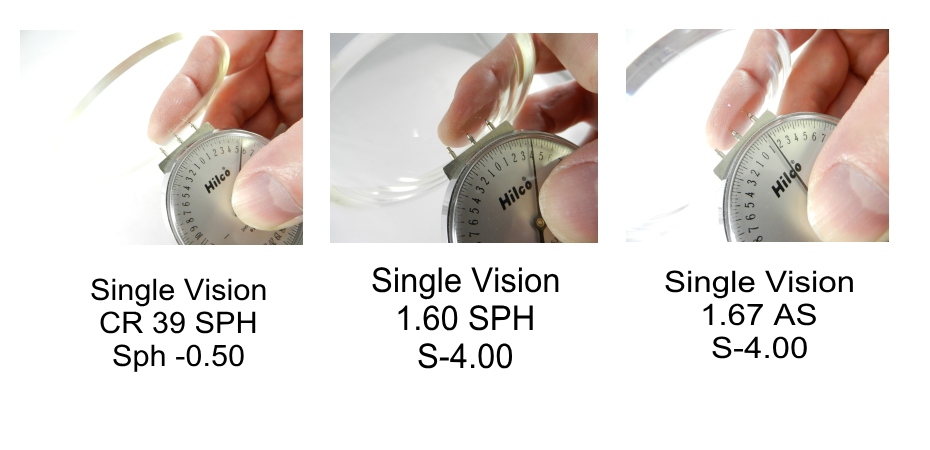 We can measure RX lens base curve by Lens Clock. (This pictures shows stock lenses only. Order-made lenses can be made in most base curve. ) Left pic is low myopia power. Lens clock is 5.5 base curve. If you choose higher Index lenses, this curve will be small number. Center pic is Hi-Index 1.60 Spherical lens in -4.00D, Right pic is Hi-Index 1.67 Aspheric lens in same power. You will see there is a big difference between two pics. If you want to choose your favorite frame and lenses, please start to think about frame & lens base curve from now. |